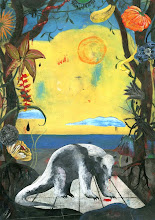
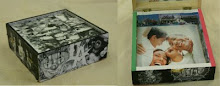
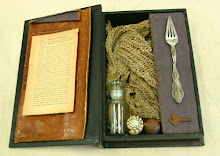
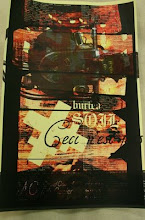
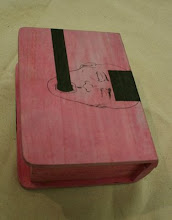
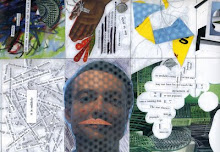
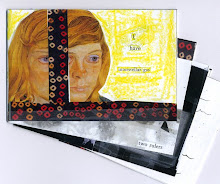
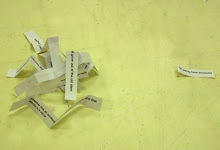
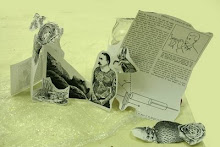
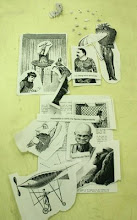
For this piece, students were to respond to the work of an artist-writer pairing--in this case the artist Kerry James Marshall and the writer George Saunders--and make, in the space of an hour, something that responds to either Marshall, Saunders, or some combination of the two. Some students took pieces that were made prior to the assignment and disrupted them in some way; some students prepped for a while before they got to work; still others used only one hour, from start to finish. Below are some of the results.
~
Andres Ramirez:
~
Bethany Foster:
~
Caylie Smith:
~
Claire Jacobson:
~
Erica Mahnke:
~
Fae Naughton:
~
Katherine Sherlock:
~
Irene Paek:
~
Hannah Strandberg:
~
David Giles:
~
Kyol Shorack:
~
Lydia Meyerdirk:
~
Marijane Fasana (Something is Off):
~
Megan Bass:
~
Micayla Jones:
~
Shell Grizzard:
~
Esther Hedin (skeleton with a mullet contemplates his geode):
~
Olivia Blair:
~
Brendon Sylvester (Untitled):
Charlie flailed his chubby hands at the stuffed-animal bunnies hanging from the mobile above him. They all wore pajamas, and slept on different parts of the sky. One used a little cloud for its pillow, another a star, another a little crescent moon. Fred, Charlie’s adopted father, watched him happily. Charlie’s chocolate skin was stark against his crib’s white blanket. They’d done a good thing in adopting Charlie, him and Diane. The foster cycle was miserable. They had a chance to raise him with good parents, in a nice neighborhood, maybe send him to a private school...not that they were his saviors or anything, the white parents saving the black kid—
“Any children you have on this plantation aren’t yours. They’re mine.”
“Daddy, how come I’m brown and you’re not?”
Oh no. How could he answer that question without—without what? Racially oppressing his son? One had to be very careful in these situations, use very precise rhetoric so that Charlie wouldn’t get the impression that he was—no, that Fred thought he was worse or inferior or even the same without talking at all about the history of racial oppression while also remembering that this was a little boy, his Charlie wearing untied light-up shoes and a Spiderman jacket and big brown innocent eyes that hadn’t seen or heard about any of this and he first had to explain the whole adoption thing to him, where was Diane?
“Listen, little ———. Get this in your head early. You’re not one of us. You can’t eat here, you can’t eat this food, you have to eat in the lodges with all the other ———s”
“Dad, what does ——— mean?”
Fred turned around and Charlie’s eyes were red. Oh nonononononononono—how could he, what could he, why were white people—
“Who said that? Did someone call you that?”
“Yeah,” he said slowly “Elliot, from school. What does it mean?”
Elliot from school. How does a third grader—
“That—it’s a very bad word that, um, white people—other white people, I wouldn’t—it was back in the old days—it’s a mean thing to call black people, Charlie, they did it in the slave days, when white people used to keep black people as slaves.”
“Oh.
“Did your grandparents have slaves, Dad?”
Why? Why why why did he have to answer these things? Was this a bad idea? Was he trying to rectify a thing that could never be rectified by playing Jesus in a way that just ended up hurting—
“I—um—I, yeah, I uh—I, I think they did, Charlie”
“It’s funny how quick they take to the whip sometimes, isn’t it? You’d think they wouldn’t like hittin’ their brothers. Just goes to show, I guess.”
“Well, mom, dad—I’ll see you at Thanksgiving—”
“You’ll visit more often than that, right?”
“He doesn’t have to, Diane—did you meet your roommate since Wednesday?”
“Yeah. Some white guy.”
Diane squinted—“You know that we’re...”
“I know, I know. See you, mom.”
“Can always tranfer to Bob Jones,” said Fred.
Charlie laughed, “Can always transfer to Bob Jones. Bye Dad.”
They hugged, Charlie went inside, and Fred and Diane left.
Did they do it right? What would it be like for him having had white parents, did they give him enough, or were there some things...?
~