Tuesday, April 1, 2014
Hybrid Book/Arts Workshop
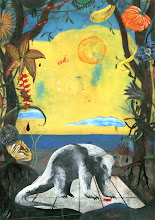
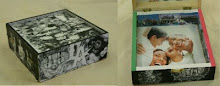
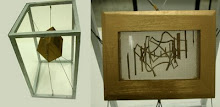
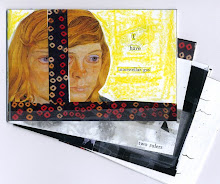
The Kenyon Review is offering a Hybrid Book / Arts Workshop this summer. It's not cheap, but any student in this class would recognize the appeal of this kind of thing. More information, including some examples of the kinds of hybrids people will be making, is here.

LACMA & Bender
This past weekend, the class went to LACMA to look at, among other things, the two Joseph Cornell boxes; process paintings by Frank Stella, Ellsworth Kelly, Robert Motherwell, and others; and to explore whatever else caught the eyes of students working to integrate image and text in collaborations. Students who hung around Dan got to hear him wax on the paintings in the Picasso room and one of his favorite paintings in all of LACMA, "Nude on a Chair" by Edouard Vuillard. Students were also implored to see Chris Burden's "Metropolis II," his sons' favorite thing at the museum. At any museum, actually.

We also had a visit from the writer Aimee Bender, who sat with us on the lawn across from Michael Heizer's "Levitated Mass" and about her writing practice. Pre-parenthood, she set aside two-and-a-half hours, six mornings a week to work. She said she would turn off her Internet access, turn off her phone, and show up at her desk and see what would come. She downplayed inspiration and expectation, telling us that you need to let your mind go dull, to be bored, so that you can then take risks and make something, anything, in the time you've set for yourself. Most (all?) of her strangest, most satisfying fiction has come from this process. Since she's had children, she takes what time she can get, even if it's ten minutes every evening, to get some writing done. The point is to show up, to make stuff and not to worry about its importance or how good it is. She shared with us this passage from Anne Lamott's book Bird by Bird:

We also had a visit from the writer Aimee Bender, who sat with us on the lawn across from Michael Heizer's "Levitated Mass" and about her writing practice. Pre-parenthood, she set aside two-and-a-half hours, six mornings a week to work. She said she would turn off her Internet access, turn off her phone, and show up at her desk and see what would come. She downplayed inspiration and expectation, telling us that you need to let your mind go dull, to be bored, so that you can then take risks and make something, anything, in the time you've set for yourself. Most (all?) of her strangest, most satisfying fiction has come from this process. Since she's had children, she takes what time she can get, even if it's ten minutes every evening, to get some writing done. The point is to show up, to make stuff and not to worry about its importance or how good it is. She shared with us this passage from Anne Lamott's book Bird by Bird:
E.L. Doctorow said once said that 'Writing a novel is like driving a car at night. You can see only as far as your headlights, but you can make the whole trip that way.' You don't have to see where you're going, you don't have to see your destination or everything you will pass along the way. You just have to see two or three feet ahead of you. This is right up there with the best advice on writing, or life, I have ever heard.And then she took student questions. It was gracious for her to join us, in the brief time she had, and students were encouraged and make time to let themselves be bored in the service of their work.
Monday, March 31, 2014
Text under the influence of Joseph Cornell
Olivia Hays:


Passio
 ~
~
Victoria Van Vlear:
~
Connor Collins:
 ~
~
Kent Reister:
~
Brianna Chavers:
Midnight at Gatsby’s, featuring guests from various boxes
There was music from my neighbor's house through the summer nights. In his blue gardens men and girls came and went like moths among the whisperings and the champagne and the stars. At high tide in the afternoon I watched his guests diving from the tower of his raft, or taking the sun on the hot sand of his beach while his motor-boats slid the waters of the Sound, drawing aquaplanes over cataracts of foam. On week-ends his Rolls-Royce became an omnibus, bearing parties to and from the city between nine in the morning and long past midnight, while his station wagon scampered like a brisk yellow bug to meet all trains.
A silver Sebring emerged out of the dark road and came to a stop on the vast lawn. Two men exited the vehicle.
“Thanks for inviting me along,” the first man said. He had a moon shaped face and wore thick glasses.
“Oh, sure. Really didn’t give it any thought.” The second man was slightly smaller in stature. He held a Tupperware container of what appeared to be potato salad. They started up the lawn towards the house, walking slowly. Their heads tilted back as they took in the enormity of the house. Then downwards, comparing themselves with the people, some of which were diamond studded and carrying long flutes of champagne which created a sweat on their fingers. Others buzzed around the room in tuxedos with long tails floating behind them as they carried trays and plates of food to and fro. The two men slowly came to a halt.
“Michael, you’re dressed exactly like the servants--,”
“—Shut up. Okay, change shirts with me.” They walked hurriedly to the shelter of a nearby tree.
“Wait. I don’ think yours’ will fit me,” said Dwight.
“I don’t care.” They struggled to pull their shirts off of their back, unknowingly putting on a show for those who stood a mere forty feet away.
“That would have been really embarrassing,” commented Dwight as he finished his last buttons. “Crisis averted.”
Tiny smiles began to creep across their faces, like two boys with a secret as they walked back into the party. Michael hardly noticed those who were rolling their eyes or staring, slightly amused as they downed their champagne. At the bottom of the front steps, he clutched his potato salad between two hands as he searched for a spot to put it. Magically, a servant approached with an empty tray perched on his shoulders and Michael quickly set the Tupperware on the tray as the server whizzed past him. Michael began to ascend the marble steps, clearly satisfied with his wit, as the servant halted to see what had been placed on his clean, sterling silver platter. He lifted the warm salad off of the tray, raising his nose to the sky while his lips protruded downward in disgust. The servant waltzed past a row of small table where guests enjoyed the scene to a trash bin where he dumped the unwanted food.
Sitting near the trash bin were a man and woman, who seemed to be surrounded by the awkward air of a blind date.
“That's the Marilyn Monroe section, that's Mamie Van Doren... I don't see Jayne Mansfield, she must have the night off or something…” explained the man.
The woman nodded, either unimpressed or intimidated by the celebrities in her midst. Another awkward silence filled the moment, as she checked her make up with her compact mirror. Finally, an interesting thought popped into her head as she snapped her mirror shut.
“Don't you hate that?,” Mia asked.
“What?” asked Vincent.
“Uncomfortable silences. Why do we feel it's necessary to yak about bullshit in order to be comfortable?”
“I don't know,” said Vincent. “That's a good question.”
Mia brought the straw of her milkshake to her lips and took a small swallow, “That's
when you know you've found somebody special. When you can just shut the f*** up for a minute and comfortably enjoy the silence.”
Vincent nodded and gave a little smile. Behind him a crowd broke out in uproarious laughter, he looked back to see what was going on.
“Vincent, do you still want to hear my Fox Force Five joke?” Mia asked.
“Sure, but I think I'm still a little too petrified to laugh.”
“No, you wont laugh, 'cus it's not funny. But if you still wanna hear it, I'll tell it.”
“I can't wait."
“Three tomatoes are walking down the street- a poppa tomato, a momma tomato, and a little baby tomato. Baby tomato starts lagging behind. Poppa tomato gets angry, goes over to the baby tomato, and smooshes him... and says, Catch up.”
Vincent looked up at Mia as his faced relaxed into a warm smile. She smiled back, before grabbing her clutch from the table and standing up.
“I have to go powder my nose,” she said and walked away.
Mia walked swiftly up the lawn, passing through the various cliques. To her left a white haired man in a suit, stood clumsily on top of a table. Broken glass and food were falling to the grass as the older gentlemen walked drunkenly across the table, his eyes fixated on the moon.
His stretched his hand toward the sky, calling out to it saying, “And further still! At an unearthly height! A luminary clock! Stood against the sky!”
The other people at the table seemed both amused and disturbed. Mia hurried past them until she reached the house. In search of a bathroom, she walked down a long hall in which people were lined up against the wall. Assuming this was a line to a bathroom, she fell into place behind the other ten or twenty people.
Before another minute could pass, to her left, a man stormed down the hall, away from another man being pulled into room by a woman.
As he walked away huffing, he exclaimed, “They’re a rotten crowd. You’re worth the whole damn bunch put together!”
The whole event was confusion and all of the people involved were as well. But, it brought to mind that in my younger and more vulnerable years my father gave me some advice that I’ve been turning over in my mind ever since: “Whenever you feel like criticizing anyone,” he told me, “just remember that all the people in this world haven’t had the advantages that you’ve had.”
~
Reina Beruman:


 ~
~
Jeanne Halstead-Doucette:


You See It
You cannot sink once
you start to swim.
Can you see that this
is fitting?
Low it floated, then
high, and fell flat.
You cannot swim? You
can sink to start.
That is fitting, can
you see this?
It fell flat—high and
low, then floated.
You sink once, you
cannot swim to start.
You can see that this
is fitting.
Then high it floated,
flat, low, and fell.
You start to sink,
you cannot once swim.
You see fitting, can
this that is?
Floated high, fell
low, and then flat.
You cannot swim? To
start, you once sink.
Can that see you? Is
this fitting?
High. Floated it and
then fell flat, low.
You once start to swim,
you cannot sink.
This can see you;
that is fitting.
Fell and then low,
flat, it floated high.
~
Jake Anderson:
~
Michael Asmus:
~
Katherine Baker:
~
Joshua Patch:
Passio
Whether passing by
in fearful silence might seem
filled with dread purpose or not
to a poised black jaguar, you will
go
on from there with the sticky
residue
of its yellow look upon you
as an analog to the elm sap
of which you are more and more
smelling,
or it may be that you die, its hot
teeth in you.
Claritas
What we shall need:
protractor, laser beam, plumb
line,
auger, grass-seed, an eye
trained in sea- and forest-greens,
path-gravel ground of
millionaires’ tabletops; supposing
you know a little of
the actors who’ll be walking among
such aligned palm trees.
~
Daniel Larson:
Victoria Van Vlear:
“Go play in the garden,” she says.
Garden? I’m an explorer—I go.
The green is frightening. It goes on forever. Tiny
swords, pointing up. Treacherous. The fence, ages away. Do I dare? Start wading
through. Cold—feet are wet.
Something hard. A rock! Big—fills my whole hand.
Hard—edgy. A treasure. I hold on tight.
Big color up ahead. I trek. Lots of shapes, all red.
There’s a gagillian—all the same. They smell good! I want one—another treasure.
I pull. It falls.
Dirt. Brown, like my teddy bear upstairs. The one with
the beaded eyes. Heavy—light. Sticking to my hands. Under my nails.
Movement in the dirt. Wriggling body, like a dance.
Long and skinny—how does he move? I touch him. Slimy!
More movement. Bulging bodies, little legs—hurrying,
scurrying. A line of them. Follow the leader. What happens when they squish? I
try. Sticky, gooey finger. Smells funny. The line won’t stop—more of them. They
go up.
Mommy calls this a tree. I don’t believe her—name is
too small. No end; I can’t see the top. Like a giant. Booming legs, arms that
wave.
Stands still, this giant. Legs are rough—papery.
Little cracks. I wedge my fingers in. Can’t pull off his skin—too strong.
Sticky hands now. Is the giant sweating? Wiping my
shirt doesn’t help.
I start the trek back. Garden, Mommy calls it. It’s
the whole world.
~
Connor Collins:
Kent Reister:
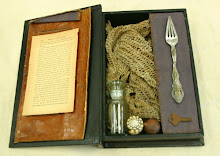
Junk Drawer
Log Time: 3-1-14 from 2:45pm-3:15pm and 5:45pm-6:15pm
My
mother’s drawer was full
Of colored
threads and sewing needles
That stuck
through
The telescopes on the Gold Hill observatory
post card.
The card’s
shimmering face showed old men with white
Beards
peering through magnified glass
At the
junk drawer of God;
Glinting
like fools gold in arranged constellations.
While
rummaging it was a pleasure to feel my fingers wade through
The twenty
five cent bouncy balls from the post office;
Rattle the
saved baby teeth in the snuff boxes,
And
examine every blade from the pen knife initialed
With
shallow etched letters and spots of rust.
It was the
undisclosed locations of 144 N. Main that
Were
always the finest to rediscover, as
I picked
up an old leather book, scratched by thumb tacks and
Blew the
dust off the hide face to be
Reminded
that God made desert islands for
Crusoe’s to wreck on.
I picked up the metal travel tubes for
Tooth
brushes, no longer needed by their skeleton teeth.
Un oiled
locks forgotten by their skeleton keys,
And locks
of hair un brushed by skeleton memories.
I see a picture
of my bald grandpa on that camping
Trip where
he taught
Three
pairs of eight year old hands how to
Decorate
the fishing lines with the same silver hooks
And
glinting lures that were scattered in the wood grain corners.
Underneath
the picture was a stack of old calendar pages from 1987, 90, and 95
That mark
time for the figurine bears dancing
Like
ballerinas in stop motion progression
Every few
months the drawer opens.
And I
look, as if through the wrong end of the telescope,
With a beard not so white, and I see shapes
like the glassless rims of the old spectacles
In the cock roach crawl space—I take on eyes
for
Seeing and
only find my deficits magnified—my images and memories
Unkept and
tattered in the restricted extravagance of the mind.
I search
through the mildew pages of a dime novel where inscribed I find
“For Mikey,
on his birthday. I love you son”- signed
Dad 1996,
With no official copyright, except a signature
of
Magnified love with no exceptions for
plagiarism or revision.
In its
pages are the pressed leafs of a pasture oak
And a cross
stitched bookmark displaying the backs of two lovers at sunset.
I gaze at the dry thread marks and leaf veins.
These old artifacts: Once
Stitched
to life by old branches and hands whose care was once organic and deliberate,
Are now laid
to rest in the 24x12 inch sepulcher of deep stained mahogany.
Brianna Chavers:
Midnight at Gatsby’s, featuring guests from various boxes
There was music from my neighbor's house through the summer nights. In his blue gardens men and girls came and went like moths among the whisperings and the champagne and the stars. At high tide in the afternoon I watched his guests diving from the tower of his raft, or taking the sun on the hot sand of his beach while his motor-boats slid the waters of the Sound, drawing aquaplanes over cataracts of foam. On week-ends his Rolls-Royce became an omnibus, bearing parties to and from the city between nine in the morning and long past midnight, while his station wagon scampered like a brisk yellow bug to meet all trains.
A silver Sebring emerged out of the dark road and came to a stop on the vast lawn. Two men exited the vehicle.
“Thanks for inviting me along,” the first man said. He had a moon shaped face and wore thick glasses.
“Oh, sure. Really didn’t give it any thought.” The second man was slightly smaller in stature. He held a Tupperware container of what appeared to be potato salad. They started up the lawn towards the house, walking slowly. Their heads tilted back as they took in the enormity of the house. Then downwards, comparing themselves with the people, some of which were diamond studded and carrying long flutes of champagne which created a sweat on their fingers. Others buzzed around the room in tuxedos with long tails floating behind them as they carried trays and plates of food to and fro. The two men slowly came to a halt.
“Michael, you’re dressed exactly like the servants--,”
“—Shut up. Okay, change shirts with me.” They walked hurriedly to the shelter of a nearby tree.
“Wait. I don’ think yours’ will fit me,” said Dwight.
“I don’t care.” They struggled to pull their shirts off of their back, unknowingly putting on a show for those who stood a mere forty feet away.
“That would have been really embarrassing,” commented Dwight as he finished his last buttons. “Crisis averted.”
Tiny smiles began to creep across their faces, like two boys with a secret as they walked back into the party. Michael hardly noticed those who were rolling their eyes or staring, slightly amused as they downed their champagne. At the bottom of the front steps, he clutched his potato salad between two hands as he searched for a spot to put it. Magically, a servant approached with an empty tray perched on his shoulders and Michael quickly set the Tupperware on the tray as the server whizzed past him. Michael began to ascend the marble steps, clearly satisfied with his wit, as the servant halted to see what had been placed on his clean, sterling silver platter. He lifted the warm salad off of the tray, raising his nose to the sky while his lips protruded downward in disgust. The servant waltzed past a row of small table where guests enjoyed the scene to a trash bin where he dumped the unwanted food.
Sitting near the trash bin were a man and woman, who seemed to be surrounded by the awkward air of a blind date.
“That's the Marilyn Monroe section, that's Mamie Van Doren... I don't see Jayne Mansfield, she must have the night off or something…” explained the man.
The woman nodded, either unimpressed or intimidated by the celebrities in her midst. Another awkward silence filled the moment, as she checked her make up with her compact mirror. Finally, an interesting thought popped into her head as she snapped her mirror shut.
“Don't you hate that?,” Mia asked.
“What?” asked Vincent.
“Uncomfortable silences. Why do we feel it's necessary to yak about bullshit in order to be comfortable?”
“I don't know,” said Vincent. “That's a good question.”
Mia brought the straw of her milkshake to her lips and took a small swallow, “That's
when you know you've found somebody special. When you can just shut the f*** up for a minute and comfortably enjoy the silence.”
Vincent nodded and gave a little smile. Behind him a crowd broke out in uproarious laughter, he looked back to see what was going on.
“Vincent, do you still want to hear my Fox Force Five joke?” Mia asked.
“Sure, but I think I'm still a little too petrified to laugh.”
“No, you wont laugh, 'cus it's not funny. But if you still wanna hear it, I'll tell it.”
“I can't wait."
“Three tomatoes are walking down the street- a poppa tomato, a momma tomato, and a little baby tomato. Baby tomato starts lagging behind. Poppa tomato gets angry, goes over to the baby tomato, and smooshes him... and says, Catch up.”
Vincent looked up at Mia as his faced relaxed into a warm smile. She smiled back, before grabbing her clutch from the table and standing up.
“I have to go powder my nose,” she said and walked away.
Mia walked swiftly up the lawn, passing through the various cliques. To her left a white haired man in a suit, stood clumsily on top of a table. Broken glass and food were falling to the grass as the older gentlemen walked drunkenly across the table, his eyes fixated on the moon.
His stretched his hand toward the sky, calling out to it saying, “And further still! At an unearthly height! A luminary clock! Stood against the sky!”
The other people at the table seemed both amused and disturbed. Mia hurried past them until she reached the house. In search of a bathroom, she walked down a long hall in which people were lined up against the wall. Assuming this was a line to a bathroom, she fell into place behind the other ten or twenty people.
Before another minute could pass, to her left, a man stormed down the hall, away from another man being pulled into room by a woman.
As he walked away huffing, he exclaimed, “They’re a rotten crowd. You’re worth the whole damn bunch put together!”
The whole event was confusion and all of the people involved were as well. But, it brought to mind that in my younger and more vulnerable years my father gave me some advice that I’ve been turning over in my mind ever since: “Whenever you feel like criticizing anyone,” he told me, “just remember that all the people in this world haven’t had the advantages that you’ve had.”
~
Reina Beruman:
Jeanne Halstead-Doucette:
Friday, March 28, 2014
Texts
Recent Course Texts:
Marjorie Perloff, "Toward a Conceptual Lyric"
Michael Robbins, "Ripostes"
Marie Howe, "The Poetry of Ordinary Time"
Dorothy Sayers, "Toward a Christian Esthetic"
And, our artist / writer pairing for this round is Steve Roden and Jorge Luis Borges, whose work we've been looking at the past coupla weeks. The first artist / writing pairing was Joseph Cornell and Marianne Moore. The next will be Andy Goldsworthy and Frank O'Hara.
Marjorie Perloff, "Toward a Conceptual Lyric"
Michael Robbins, "Ripostes"
Marie Howe, "The Poetry of Ordinary Time"
Dorothy Sayers, "Toward a Christian Esthetic"
And, our artist / writer pairing for this round is Steve Roden and Jorge Luis Borges, whose work we've been looking at the past coupla weeks. The first artist / writing pairing was Joseph Cornell and Marianne Moore. The next will be Andy Goldsworthy and Frank O'Hara.
Thursday, March 27, 2014
Visual Art in Conversation with Marianne Moore

Katelyn Seitz

Alyssa Martin

Lauren Higgins

Nico Hernandez

Gaven Heim

Lori Lusk
Wednesday, March 26, 2014
"Writing as Art"
Current student Victoria Van Vlear has written a thoughtful piece about this class on her blog. You can read it here.
Monday, March 24, 2014
Borges & "Slacker"
We've been reading stories by Jorge Luis Borges, including "The Garden of Forking Paths." Looking at written student responses to its plot, which traffics in philosophical concerns of the circularity of time and imagined (and possible) multiple realities for any one life, I thought of the opening scene of Richard Linklater's first movie, Slacker. Worth watching for, if nothing else, the blankness of the cabbie's face. But I think there's plenty of "else" here:
Wednesday, March 19, 2014
Restrictions on the Work

'“Artwork facilitated conversation. And it humanized me to some of the guards. They saw me not as an inmate but as a person.”'
'Krimes said that his profoundly isolating and dehumanizing prison experience had changed him not only as a person but as an artist.'
'Working in isolation for five years with limited resources and materials has created an urgent desire to create and collaborate and to help criminals who are locked up to maintain a connection to the outside world.'
Read more here and here.
Inspiration
Student Sarah Sundberg said she was inspired by some music in a way that touched on her work in this class, and she was wondering if she could share it here. We said, "Sure!" The music in question is "Beth/Rest (Rare Book Room Version)," by Bon Iver. Listen below.
Thursday, March 6, 2014
Class Visitor
Today, Aaron Belz visited the class, reading poetry from his new book, Glitter Bomb, and talking to students about influences, writing habits, the value of compression, and the lessons about language that comedy and context offer. We had a blast. He's reading on campus tonight, in the art gallery.

Monday, March 3, 2014
Last week
I was hoping to post a more thorough run-down of what we did last week, but here are some of the highlights. We began the week Tuesday with our song-of-the-day, sung a cappella by student Stevi Daniels in the painting studio. We watched a section of a wonderful Joseph Cornell documentary, which you can find here, and we learned that he would loan his boxes to children in his neighborhood to play with. (Apparently, on a visit to Cornell's house check out his work, Andy Warhol witnessed a little girl stop by and return in a box she was "bored with" and was given by Cornell another to play with.)
We read and discussed three Marianne Moore poems: "A Grave," "What Are Years?" and "An Egyptian Pulled Glass Bottle in the Shape of a Fish." Included in the discussion of these poems were some notes drawn from Langdon Hammer's lecture on Moore, which can be found here.
Finally, we read two essays, Christian Wiman's "Dear Oblivion," from his book My Bright Abyss, and Stanley Hauerwas's "How to Write a Theological Sentence." The discussions we had were robust and freewheeling.
A full week indeed.
We read and discussed three Marianne Moore poems: "A Grave," "What Are Years?" and "An Egyptian Pulled Glass Bottle in the Shape of a Fish." Included in the discussion of these poems were some notes drawn from Langdon Hammer's lecture on Moore, which can be found here.
Finally, we read two essays, Christian Wiman's "Dear Oblivion," from his book My Bright Abyss, and Stanley Hauerwas's "How to Write a Theological Sentence." The discussions we had were robust and freewheeling.
A full week indeed.
Saturday, March 1, 2014
Text/Image Collaboration




Subscribe to:
Posts (Atom)