VVP: Art 434 & Engl. 410

Website for Vision Voice and Practice: An Interdisciplinary Course in Art and Creative Writing

Monday, March 25, 2013

Poem in Conversation with Joseph Cornell

Historical Fragments

We sat on the bridge again last night.
The fog swallowed my fingers while
the homeless man skimmed gold-rimmed pages.

I sobbed in my father's arms after finishing Brothers K and
wiped my snot on the cement steps.
No one ever chooses to learn to be patient.

When I dream of you we never kiss,
a radio crackles and paintings fall off of museum walls,
my grandma blows bubbles in a thunderstorm.

My roots grow deeper
than any grave I can dig.
Pine-needles get stuck between my toes.

Things will always be muddy.
There will always be sunflowers.

- Rebecca Johnson

Prose in Conversation with Joseph Cornell

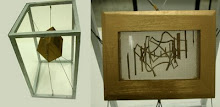
To the top and you will find a library built with wood and webs with a stone in the middle. Approach it, it's not alive. Feel the figure, it is cold and the shards below are evidence of its age. It was a perfect cube, in the beginning, with six faces: a brother, a sister, a mother, a father, myself, and a neighbor or the stranger. Complete with curiosity I found enemies through the years who deceived me, they exchanged my love and acceptance with deceit and manipulation. The faces were fractured and where there was once completion entered confusion. I could not comprehend who was good from who was evil, thinking myself to blame, I took he whom I loved most and sacrificed my brother upon my sharpened stone for guilt's sake but found no relief, only a quick rinse of his warmth before it dried. Then my father, then my sister. Finally, the stone became too fractured for sacrifice. Its edges grew dull as the cube softened to a sphere of profound complexity, confusion, yet simultaneously singular in face and simplicity.

- excerpt from a longer piece by Mikel Barajas Carrión

Poem in Conversation with Joseph Cornell


"Untitled"

The bus, stopped and broken,
Taking space on the freeway side
As cars flew past and left
Exhaust and smoke that drifted through
Opened windows
To the people trapped inside.
They say it's a flat tire,
Said the man from Boston
Who knew no nonsense.
He looked outside then at his watch,
As a curse fell from his lips.
Engine trouble, said the Texan,
The heat barely bothering him,
As he gazed past the freeway
And imagine open spaces
Where the concrete stood.
I heard there was a crash,
Timidly voiced the girl from Iowa.
She was far from home
And wished that she could finish the letter
Written to her family in the East.
The fourth man said nothing,
His clothes and hat
Having no identity as his eyes focused
On cars and trucks.
He seemed content to sit and wait
Till whatever the problem was had passed.
He was not from anywhere,
And this bus would not be his last.

- Matt Glass

Poem in Conversation with Joseph Cornell

- Jonathan Diaz

Poem in Conversation with Joseph Cornell

Secret Histories

Her paranoid eyes glance as if to say,
"Don't look at me."
She's put herself in a
box, framing what others are allowed to see--
She doesn't smile.
She keeps her head down.
Closed off and hidden
behind fragile glass she is less than safe.

Tall shadows fall on the street.
Buildings shoot to the sky--their white
faces dirty from smog and age.
The sun exposes their blemishes.
The night reveals their charm.
It is the city that pulses and
scrambles with life.

People haunt her. They smile,
eyes staring straight at her.
Even the noise of the city can't drown
their voices.
She is known and like the buildings
she feels dirty, but can't hide her blemishes.
She chose this.

- Hannah Perry

Poem in Conversation with Joseph Cornell

Dear Mr. Potesta,

neighbor and valued customer,
First of all, I want to commend you on how much you've
       grown since Zambia,
Man Wearing Khaki Coveralls.

I know we don't talk as much as we used to,
but Lou Williams scorched the Knicks
and I lost count of how many steps after ninety-nine.

I wish you would have told me about this tradition
before you already left
so I could write you a legitimate one.

This is a gift:
ninety-seven cents for a dozen eggs,
I thought the colors would match your new room,
but just use a symbol like we talked about.

Don't ever forget:
I adore these books,
so it says a lot for you that I'm sending them
       across the miles.

Do not ever forget:
One day my family and I drove and drove and drove,
and Philip was standing next to the chariot
and I hope this is all making sense.

If it isn't,
if you need to change your appointment for any reason,
you may want to look beyond the internet-savvy throngs
       clogging the sidewalks and bars here.

This is all just to say
that Kovalchuk waited out Grossman,
and tagging along was a conviction as strong as
       anything I had ever felt.

Love always,
The Editors.

- Justin Potesta

Poem in Conversation with Joseph Cornell


"Cassiopeia" and All the Rest

Constellations are
The organization of men.
They were not made by men,
But the existence of stars means
Man's mulish impulse
To order them--to take
What is chaotic, large,
Perhaps even already dead,
And draw imaginary,
Unenforceable lines until
A picture spreads wide across
The sky, and stories the traveler
Over latitude and longitude,
Mountains and sea,
Reflecting heavens
Which are no longer
Flat and which sing
Fiery epics to the blinking
Beat of stars.

- Sarah O'Donnell

Poem in Conversation with Joseph Cornell

Cornell Meets Silverstein
A place to elude the weighty stresses
of life. A seat shaped and molded to provide com-
fort for minutes or even hours upon
time. Paper light and soft reassuring
the bearer that progress is being made
and bounds overcome. Four walls and a lock
to prevent interruption and ensure
safety. A handle that will case your trou-
bles into the see. And finally, a
continuous flow of water to wash
away what you don't want to see.

- Julius Thompson

Thursday, March 14, 2013

Submitting to the Body and Transfiguration


We talked, briefly and obliquely, a few classes back about how often in a piece's material specificity are hints of the sublime, sometimes full flowering into an experience that resist verbal or written formulation. The last seventeen or so lines of Elizabeth Bishop's poem "At the Fishhouses" is like this for me, as is Rebekah Del Rio singing "Llorando" in Mulholland Drive.

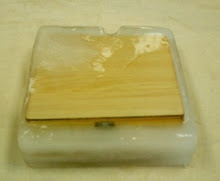
Anyway, what came to my mind this morning was the Transfiguration. We read in Matthew 17 that Jesus took John, Peter, and James to a "high mountain," and "There He was transfigured before them. His face shone like the sun, and His clothes became as white as the light." How could this happen if not for the submission of an infinite idea into a finite frame--i.e. God into a human body. Such faithfulness to form--and to forms, whom he came to serve--and the rules governing those forms breaks out (inevitably?) beyond the frame into something unrepresentable. Note the minimalism of the description: "His face shone like the sun, and His clothes became as white as the light"--economy of words the best tack for writers depicting what's unsayable. So, too, the artist of the above image, who had his own limitations of body and materials to contend with. In its washed-out composition, it is (admirably) more suggestive than direct.

Old Art Form in New Mode

Enjambment in the Ether

Tuesday, March 5, 2013

Percussion as Composition

Former student Robbie Kirkendall sent me a link to his short write-up of Glenn Kotche's experiments with percussion. Kotche, perhaps best known as the drummer for Wilco, uses systems for developing compositions for other instruments (such as a string quartet) by recording and modifying the percussive instruments his four limbs strike as they build and dissolve rhythms. There are some striking similarities to the visual and sound work of Steve Roden, whose work we look at in this class. Anyway, check out Rob's post on Kotche here.

Light Book

We just finished up looking at image-text collaborations that the VVP students made. This first collaboration asks students to privilege the text site over what might be considered the "picture" site. [Click for some examples.] One of our students, Juliet San Nicolas, sent us a link to a commercially produced collaboration that wouldn't have been out of place in our student work. Check it out here.

Followers