VVP: Art 434 & Engl. 410

Website for Vision Voice and Practice: An Interdisciplinary Course in Art and Creative Writing

Friday, February 2, 2018

Dorothy Sayers and Amazon

A fight to the finish

A week or so back, we read and discussed Dorothy Sayers' remarkable essay (speech, originally) "Why Work?" You can read it here, if you don't mind a few typos, or you can find it in this book. Sayers makes several arguments throughout the essay, all of which have to do with the work, or jobs, we undertake in our modern society. The devastation surrounding her as she spoke--the height of the Second World War--underscored her point about consumption and the need for humans to be re-oriented with regard to the kind of work they do and the sorts of lifestyles they will tolerate:

A society in which consumption has to be artificially stimulated in order to keep production going is a society founded on trash and waste, and such a society is a house built upon sand.

It is interesting to consider for a moment how our outlook has been forcibly changed for us in the last twelve months by the brutal presence of war. War is a judgment that overtakes societies when they have been living; upon ideas that conflict too violently with the laws governing the universe. People who would not revise their ideas voluntarily find themselves compelled to do so by the sheer pressure of the events which these very ideas have served to bring about.
Before she gives her suggestions for how to revolutionize work and consumption--suggestions that, although explicitly founded on a Christian worldview, feel very different from what we might expect from such a foundation--she asks a series of questions illustrating what a change in attitude about work might look like:
We should ask of an enterprise, not “will it pay?” but “is it good?”; of a man, not “what does he make?” but “what is his work worth?”; of goods, not “Can we induce people to buy them?” but “are they useful things well made?”; of employment, not “how much a week?” but “will it exercise my faculties to the utmost?” And shareholders in – let us say – brewing companies, would astonish the directorate by arising at shareholders’ meeting and demanding to know, not merely where the profits go or what dividends are to be paid, not even merely whether the workers’ wages are sufficient and the conditions of labor satisfactory, but loudly and with a proper sense of personal responsibility: “What goes into the beer?”
She points out one key consequence of our current habit of asking the wrong questions about work (i.e., not the questions listed in the above passage):
At present we have no clear grasp of the principle that every man should do the work for which he is fitted by nature. The employer is obsessed by the notion that he must find cheap labor, and the worker by the notion that the best-paid job is the job for him. 
We assign this essay because we want our writers and artists to think about their own vocations--to put some pressure on their thinking about whether or not they're called to be writers and artists, and if so, what might that look like as a regular practice of labor. But Sayers's essay came to mind earlier this week, in another context, when I happened across an article in The Atlantic called "What Amazon Does to Poor Cities." The whole thing is worth reading, especially as, I suspect, many of us have been ramping up our e-commerce shopping, but also as we're contemplating a landscape where work and remuneration will look very different for our soon-to-be graduates. One passage that leapt out to me:
San Bernardino is just one of the many communities across the country grappling with the same question: Is any new job a good job?
Read the rest to find out. 

Wednesday, January 31, 2018

Spot Collaboration #2: Texts in Conversation

The students were given some texts: Two Emily Dickinson poems, one Tomas Transtromer poem, and one prose piece by Jorge Luis Borges:

-->
[1212]
A word is dead
When it is said,
Some say.
I say it just
Begins to live
That day.

~

-->
[761]

From Blank to Blank—
A Threadless Way
I pushed Mechanic feet—
To stop—or perish—or advance—
Alike indifferent—

If end I gained
It ends beyond
Indefinite disclosed—
I shut my eyes—and groped as well
'Twas lighter—to be blind—

~

-->
Homewards

A telephone call ran out in the night and glittered 
      over the countryside and in the suburbs.
Afterwards I slept uneasily in the hotel bed.
I was like the needle in a compass carried through 
     the forest by an orienteer with a thumping heart.

~

-->
On Exactitude in Science

... In that Empire, the Art of Cartography attained such Perfection that the map of a single Province occupied the entirety of a City, and the map of the Empire, the entirety of a Province. In time, those Unconscionable Maps no longer satisfied, and the Cartographers Guilds struck a Map of the Empire whose size was that of the Empire, and which coincided point for point with it. The following Generations, who were not so fond of the Study of Cartography as their Forebears had been, saw that that vast Map was Useless, and not without some Pitilessness was it, that they delivered it up to the Inclemencies of Sun and Winters. In the Deserts of the West, still today, there are Tattered Ruins of that Map, inhabited by Animals and Beggars; in all the Land there is no other Relic of the Disciplines of Geography.

Suárez Miranda, Viajes de varones prudentes, Libro IV, Cap. XLV, Lérida, 1658

~

We spent time with the texts--reading them aloud multiple times with different people reading them each time, making observations and connections, and so on. We then put the students into pairs (mostly) and told them to make some sort of digital artifact that puts the texts in conversation with visual information, which they could make themselves or find. Below are the results. (Click for larger views.)

~
~
~
~
~
~


Some of what we've been doing....

We've been slow to update the blog lately, but only because the semester, which was supposed to be lighter for us, has turned out to be busier, instead. However, we've been looking at and reading a bunch of great stuff these past weeks, some of which we're putting down here, as a kind of three-weeks-into-the-semester index: Billie Holiday, Marianne Moore, Thelonious Monk, Dietrich Bonhoeffer, Elizabeth Gilbert, Joseph Cornell, Dorothy Sayers, Awad Afifi, Jorge Luis Borges, Tomas Transtromer, Emily Dickinson, Thomas Merton.

Tuesday, January 16, 2018

First Spot Collaboration of the New Semester!

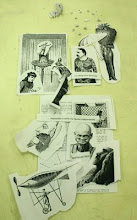
It's time for VVP 2018, and the students have already begun making cool stuff. Below are the results of our first spot-collaboration, something we do every semester. The text was taken mostly from the webpages of open tabs on my (Chris's) computer. The students were given printouts, scissors, and tape. They took care of the rest.


Friday, May 26, 2017

Image from the Smithsonian Natural History Museum Bird Storage Warehouse


Final Collaborations

Students made their final collaborations and installed them around campus on Tuesday, May 23rd. That morning, we walked around and looked at each of the things our students made. [Click on the images to enlarge and sharpen them. If you want to see works from the students' individual practices, click here.]
~
 
Dianna Hernandez and Juliette Inocelda:

~
Kat Ashdown and Matthew Porter:

~
Kelsey Meyers and Laura Webster:

~
Lauren Fitterer and Claire Zasso:

~
Lauren Frey and Brandon Steadman:

~
Anamika Gurung and Carly Evans:
 

~
Michelle Parada and Sage Theule:


~
Bri McGroarty and Andrea Riskey:


~
Emerson Lee and Sean Leone:

~
Alea Peister and Marisa Lim:

~
VVP 2017:
 ~

Followers